Bibs, Salopettes, and Waders
Salopettes is the French word for very comfy bib-and-brace overalls. The word is used in English for similar garments worn when canoeing, kayaking, diving, dinghy sailing or just playing on the beach.
There is a wide variety of sailing bibs and foul weather gear to keep you warm in the worst weather. Keep boating all year long. They have traditionally a high waist, reaching to the chest and held up by adjustable shoulder braces without the discomfort of a belt. A secure chest pocket keeps your items in place no matter how much you’re bending and moving.
Salopettes will perform beyond expectations and last several years with careful use. Most provide durable, waterproof and windproof protection while offering high levels of breathability providing the ultimate protection from both warm, wet climates and extreme wet weather conditions.
Pants or Chest Waders?
This is not just a matter of how deep you want to wade. Some people wear only rain pants if they may need to kneel down on wet grass or in a small stream.
However, if it is cold or you may need to sit on anything wet,
wear your chest waders, especially when wading from a boat.
It is always an advantage to be able to wade deep even in a shallow river or lake.
What if you suddenly had to cross the main current to follow a fish?
Waders limit the water flow over your body and thus reduce heat loss.
Snug fitting thermal clothes underneath keep warmer water near your skin,
while the cold flowing water passes outside your waders.
Sun protection is another point to consider when wading. If you want to stay covered in the water, a nice pair of bibs or waders, shirt and anorak will keep you comfortable for the entire day.
If you choose to not wear waders, then wading in a quick drying anorak and pants will allow you to go into the water more often.
Feel free to spend as much time going in and out of the water in these clothes.
For around $40 you’ll see that they’re well worth their price.
Give them a chance and you won’t be disappointed.
They’re a perfect summer outfit and won’t feel too hot no matter the temperature.
Dry Waders
Dry waders are a crucial piece of gear for outdoor enthusiasts who venture into shallow bodies of water. These specialized pants are designed to keep your lower half dry while allowing you to move freely in the water, providing protection from cold temperatures and wet conditions. You can wade into the water and stay dry, until you go in too deep and water pours in over the top.
The key feature that sets dry waders apart is their built-in boots or neoprene socks, which create a waterproof seal around the ankle area. This prevents water from entering the pant leg, keeping your legs warm and comfortable even when submerged up to waist level. The boot design also allows for good traction on slippery surfaces, making it easier to maneuver in wet conditions.
However, dry waders are not foolproof, and there is still a risk of flooding if you go too deep into the water or get caught off guard by strong currents. Falling in or flooding your waders can be dangerous, slow you down and get heavy when you return to shore. When this happens, the water can pour into your pants, weighing them down and slowing you down significantly. In such situations, it's essential to know how to deal with flooded waders.
One effective way to recover from getting flooded is to lay flat in shallow water and raise your legs to drain excess water out of the pants, one leg at a time. This technique requires some practice but can be lifesaving if done correctly. To do this:
- Find a shallow spot where you're not too deep, ideally with enough space to spread out.
- Lay down on the bottom of the body of water, keeping your feet together and legs straight.
- Slowly lift one leg at a time, allowing excess water to drain from the pant leg as it rises above the surface.
- Continue lifting both legs until you're able to stand up without any significant weight or drag.
We recommend you practice the routine a few times before you head out on any adventure.
It's great wet fun when you wear the clothes you would use on your trip.
Wet Waders
Wet waders, also known as open-bottom or semi-wader systems, are clothes designed for swimming and other water activities in shallow waters. Unlike dry waders with built-in boots or neoprene socks, wet waders have an open bottom allows for swimming and diving without restrictions. Made from a lightweight, breathable material such as nylon or polyester they are safer because they don't soak up much water. The clothes your wear underneath will get wet from the start as you wade into deeper water.
Advantages of Wet Waders:
- Improved mobility
Wet waders allow for a full range of motion, making it easier to swim, dive, or maneuver through tight spaces. - Increased comfort
Without the weight and bulk of boots, you can move more easily in shallow water, reducing fatigue and strain on your legs. - More comfort in warm temperatures
The open bottom allows for good circulation around your body, avoiding sweat build-up than with dry waders or closed-toe footwear.
Can you swim in Wet Waders?
Yes, it's possible to swim while wearing open-bottom waders. However, there are some considerations:
- Weight distribution
Waders can add weight and drag to your body, which may affect swimming performance. - Limited foot support
Without a boot, you may not get as much ankle support, which can be beneficial in rough waters. Wear sports shoes instead. - Buoyancy
Air bubbles and the material of the waders might make you slightly more buoyant in water.
To swim comfortably in Wet Waders:
- Choose a lightweight, breathable fabric for optimal comfort.
- Consider using a wading boot or shoe with a good grip for exiting the water.
- Practice swimming with your waders on before heading into deeper waters.
- Where necessary, use a flotation device or wear a life jacket to ensure safety.
Overall, open-bottom wet waders offer excellent mobility and comfort in shallow waters,
making them ideal for swimming, diving, and other activities that require freedom of movement.
Inside or Outside?
A question we often get from our readers: "Should I wear my cagoule inside the pants or outside?" As always, it depends. Your top tucked inside your waders merely invites the rain to run straight in. Outside your top will float around in the water.

When worn outside, a cagoule gives better rain protection, but flaps around in the wind, or floats in the water.
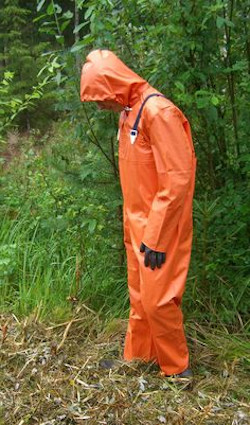
When the cagoule is worn inside, it stays put in wind and water, but rain runs into your clothes underneath.
Boots and Neoprene Socks
We wear boots or heavy shoes with socks for most of our wading. In easy terrain like shallow beaches we use water sandals.
For boots, remember to accommodate the extra bulk of the neoprene stocking foot in nearly all breathable dry waders. You should choose a boot at least 2 sizes bigger than your normal shoe size or one size larger than your wellies.
It is a bit of a nuisance to put on separate boots but the separate boots are so much better than the ones with the boots attached, in terms of support, comfort, protection from water pressure when wading deep and in terms of soles available. Always go for the stocking foot and separate boots.
New amphibian soles are the way forward.
They have special sticky rubber pads and ridges on the sole
that give them similar adhesion under water compared to felt.
Look out for a proper heel which stops you slipping over on wet grass or snow.
Reader Comment: Rain and Sailing Bibs
by Rene from FranceBib trousers with a sweatshirt or hoodie are my favourite watersport clothes. I have quite a few of them that I use for rain walking, sailing, and swimming. They are simpler and lighter than my sailing trousers. What I like is they don't need a tight belt like shorts, and stay in place with more freedom to move about.
You can walk in the rain so wonderfully, a bad rainy day becomes a nice rainy day in a rain bib. Furthermore, bibs can be worn for any activity that is in connection with water. You can do of course everything else you could do in dungaree jeans.
On cooler days I add a poncho or long cagoule that is no longer waterproof. It rains a lot where I live, so I go out to the lake or beach in the rain. When I reach the water I'm already very wet, so I just keep my clothes on when I go swimming.
Camping
We sometimes go on longer camping trips where we usually wear nylon rain bibs with fleece pullovers around the campsite and in the water. These clothes dry so quickly after swimming, we just keep them on all day.
Sailing
My sailing bibs are more robust trousers with reinforced panels on knees and seat. I wear them with a tucked in cagoule to keep warm, because I often go into the water. When we launch any boats from the beach, we carry them into waist deep water, then climb in and get going. It is so nice to be able to go in and out of the water and keep warm when boating or playing on the beach. My friends also enjoy bibs and hoodies for all kinds of water play. Great fun.
Swimming
For swimming or rain walking I wear my thin nylon bibs over a sweatshirt or hoodie.
These clothes are easy to swim in, even with thermal underwear.
They create more drag than shorts, but I'm not swimming any races.
Unlike shorts or pants with a belt, they don't trap air when I jump into the water.
No billowing.
Swimming is easy for the same reason.